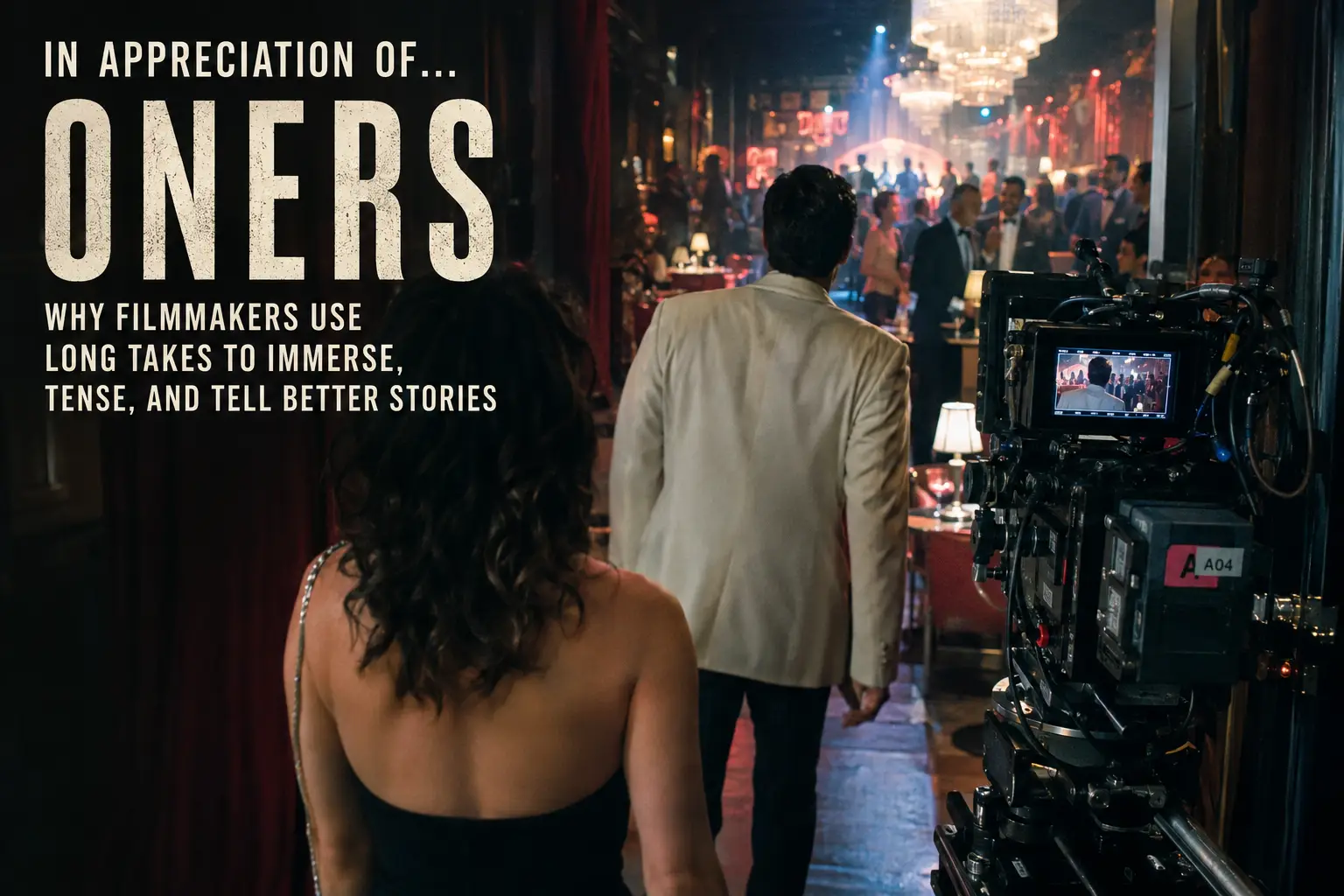
I love me a good oner.
For those of you who don’t know what that is, a quick definition: A continuous, uninterrupted camera shot in a film or television show that runs for a while without cutting. They’re also called long takes, continuous takes, and probably some other old-timey terms I’m not familiar with.
Filmmakers use them primarily for a couple of reasons. First is total immersion into the world. It drops the audience right into the action, which then unfolds in real time. The audience essentially becomes a participant, with the camera moving and taking in new information as it happens.
This leads us into the second reason: Building tension. It turns a segment of the film into something closer to a play. There are no cuts, no looking away, no coming back a few hours later or whatever. This can be particularly effective in action or emotional scenes, which allow the audience to feel at the same pace as the characters.
The downside to oners is a production one: Time and money. A lot of production sins are hidden in camera cuts. A oner gives the editor nowhere to hide. The actors need to be timed out perfectly. The lighting needs to be set for all the camera movements. So unless you have a high-budget production, any use of oners needs to be judicious.
Okay, it’s time for me to stop talking… writing… whatever… and show, not tell. Here’s a handful of great ones… and film nerds of the world, the ones I chose to show aren’t meant to be an exhaustive list of the ones I think are great.
Great Oners in Film
Goodfellas (1990)
Let’s start with one of the classic great oners in film history: Martin Scorsese’s Copacabana tracking shot in Goodfellas.
This one falls under total immersion. We’re taking Karen’s (Lorraine Bracco) point of view as her boyfriend, Henry (Ray Liotta), leads her from the car to a front row table in the world-famous Copacabana in just over three minutes. What we see is everyone bending over backward to kiss up to Henry. What we’re feeling is why Karen’s falling in love with him.
Children of Men (2006)
There are few modern filmmakers so dedicated to the use of space in the frame as Alfonso Cuarón, director of Children of Men. He’s the guy who elevated and matured the visual language of the Harry Potter series and has since won Oscars for Best Director twice for Gravity (2013) and Roma (2018).
In between, he made a modern classic: Children of Men. Where the Goodfellas oner was all atmosphere and good feeling, Children of Men’s is action, fear, and dread. The action comes out of nowhere, escalates rapidly, and never lets go. Have a look.
1917 (2019)
Director Sam Mendes and cinematographer Roger Deakins are two of the best to ever do it. A few years back, they decided to make a war film that appeared to run as a single take.
The key bit here is: Appeared.
The film uses a technique called the composite oner. This is where multiple shots are stitched together to make it look like one shot. The cuts are hidden. You can do this by panning across a dark wall, for example, or behind a character’s back.
What’s cool about 1917 is that the building blocks are themselves extremely long takes. Mendes and Deakins then hide the transitions between them, creating the illusion of one nearly uninterrupted shot.
Others
Before 1917, Birdman did the same thing: An entire film that’s made to look like a single shot. Extraction’s an action film starring Chris Hemsworth that’s better than most people realize, and has an incredible action oner in an apartment building in the middle.
Finally, there’s a surprisingly low-key champion of the technique: Steven Spielberg. Spielberg hides the technique in a lot of his films in places you don’t expect. A ferry ride in Jaws. A hallway scene in Bridge of Spies. He parks the camera in one spot and moves the actors around, usually foreground to background and back again. It creates depth and tension in areas you wouldn’t expect.
Television
Remember when I said that oners were generally time-consuming and expensive?
The West Wing, Season 1, Episode 4
That’s a major reason why elaborate oners were relatively rare in television until the last couple of decades. Television shows often used limited sets and were filmed quickly. Multiple cameras were often used to save time. Oners were a craft technique that was often a luxury.
So, of course, the first one I’m going to show you is an exception. Aaron Sorkin’s The West Wing, which first aired in 1999, was a very talky show. In that, characters talked about policy, government, and so on. One of the ways that they made the show more visually compelling was the walk-and-talk technique: Adding visual interest to conversations by having the characters move around while talking. John Wells, one of the West Wing’s Executive Producers, also employed the technique on ER (1993).
This comes from one of the early episodes:
The Office, Season 7, Episode 1
This oner was a fun way to start Season 7 of The Office. Almost over-the-top, almost ridiculous, but somehow it’s completely believable that the workers of the Dunder Mifflin Scranton branch would spend hours trying to perfect a dubbed music video.
True Detective, Season 1, Episode 4
This one swings to the opposite end of the spectrum. True Detective Season 1 was almost all about mood. Usually: dour and moody. I remember watching this one when it first came out, and my jaw was on the floor the entire time. This one includes multiple buildings, fences, helicopters… It’s just incredible. I’m gonna shut up now and let you watch it.
Editor’s Note: For some reason, I am unable to embed the clip into this site. You can see it here:
https://www.youtube.com/watch?v=vnRTITzYnXs
Others
Adolescence took the idea to its logical extreme: All four episodes were filmed as single continuous takes. Just outstanding… won a ton of awards. If you have Netflix, go see it. One I wanted to include here but couldn’t find on YouTube is Season 2, Episode 5 of Barry, where Barry fights a feral child ninja. It’s Always Sunny in Philadelphia did its own Birdman homage in Season 10, and both The Bear and The Studio did their own oner episodes as well.
Final Thoughts
I’ve had this conversation with family members. I probably had a couple of shots of Talisker and went on a bit too long one time, and was starting to get some looks. Someone finally asked the question: Why bother with oners if just a handful of film nerds notice?
Simple: You noticed, even if you didn’t. Filmmakers use a ton of different techniques to elicit emotion. Sometimes it’s cuts. Sometimes it’s not cutting. Sometimes it’s music. Sometimes it’s color. You don’t have to be consciously aware of them to feel them.
‘Cause that’s what watching great film and television is all about at the end of the day. Stick with me, we’ll talk about some more of these things down the line. Until then…
Today’s Bonus
A oner of my own. Or rather, one that I planned and directed.
Her Audition is a short film we shot in Los Angeles in 2022 with a single cameraman and no artificial lighting. I still love this shot of ours.