
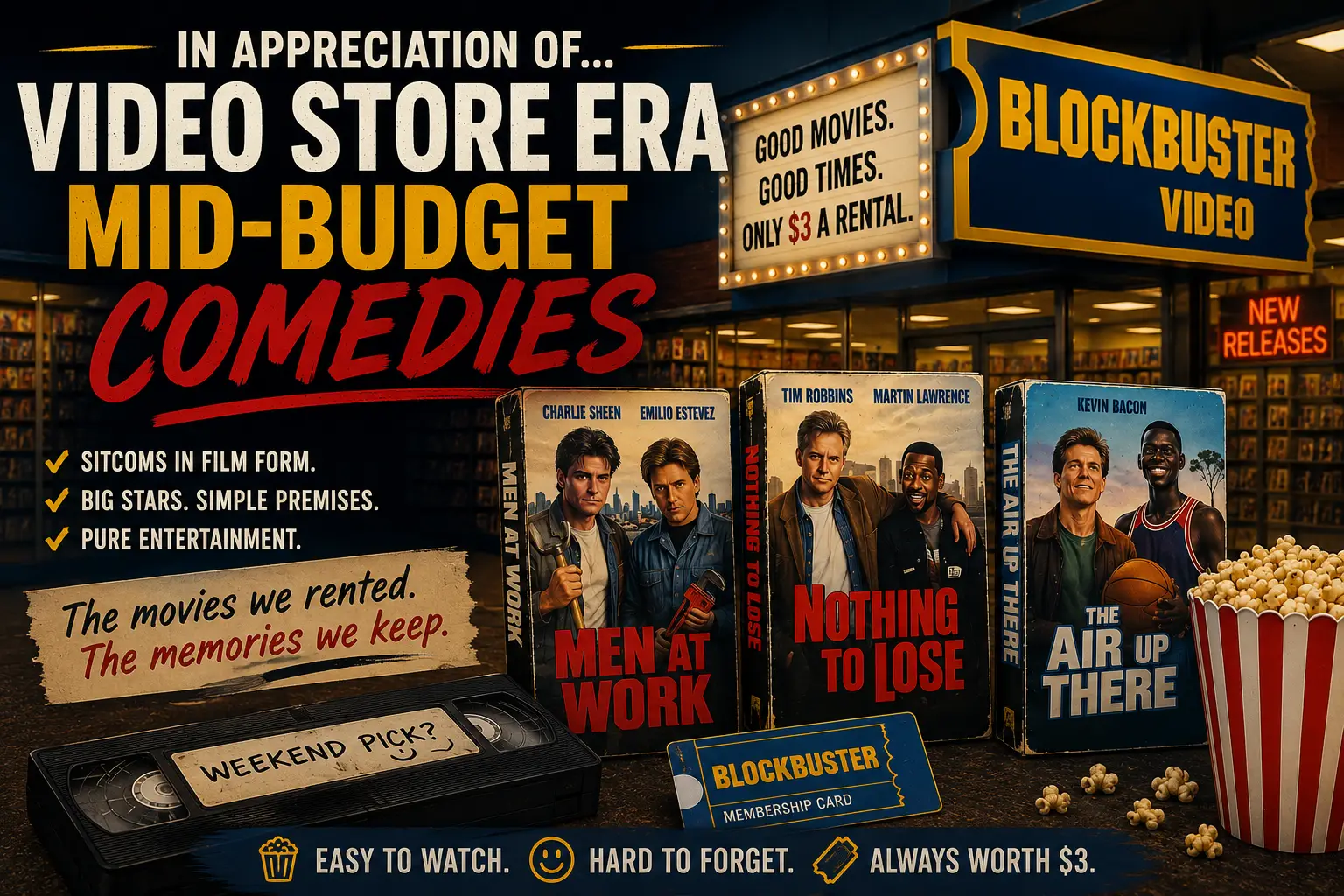
I’ve been on something of a comedy-watching kick lately. In the past few days, I’ve re-watched Men at Work (1990), The Air Up There (1994), and, as I type this, Nothing To Lose (1997).
Because I’ve reached a certain age, I started wondering in my old-man brain, “Why don’t they make movies like this anymore?” Weirdly, that’s an answer that can be tracked pretty well, and I did that a couple of weeks ago over on jackgormanfilm.com. There’s a whole set of economics around the shift in the film industry that took these out.
But this isn’t an article about boring things like money. Let’s talk about why these ridiculous comedies are fun, and maybe a little bit about why we need to make more of them.
Why do I call them video store era comedies? For that, you’ll need to read the article. 😉
What Are They?
There was a big jump in Hollywood output in the 90s. One of the biggest beneficiaries of this was the broad comedy genre.
Take, for example, 1997’s Nothing to Lose. Here’s its description on IMDb: Nick’s wife is in bed with his boss. He later gets a gun to his head by a carjacker but steps on the gas pedal. They end up friends after adventures together: holdups, burglary, reckless driving, and revenge. Twists follow.
Notice how that ends: Twists follow.
What you basically have here is a sitcom in film form. Take two near-A-list actors. Tim Robbins was coming off one of the best films of all-time in The Shawshank Redemption, and an Oscar nomination for Best Director for Dead Man Walking in 1996. Martin Lawrence launched from a successful television series to action hero in 1995’s Bad Boys. Give one of them a distinct wound, stir… hijinks ensue.
Here’s 1990’s Men at Work: Two garbage men uncover a conspiracy involving illegal toxic waste dumping and decide to bring the whole operation down. Starring Emilio Estevez and Charlie Sheen.
The Air Up There? A basketball coach travels to Africa to recruit a new star. Starring Kevin Bacon and a 6-foot-8 teenage basketball player from Kenya who had never acted before.
You know the endings of these films before you even get through the trailer. They’re pure entertainment with easy-to-understand setups, which leverage the existing brands of their leads.
Why They Were Great
Pure entertainment.
In the middle of Nothing to Lose, out of nowhere, a spider crawls across Tim Robbins’ head. Because he had spilled gasoline on his shoes, he somehow sets his feet on fire.
It’s stupid. But it’s funny. It’s memorable. Hold that thought a second.
When I mentioned to a friend I was watching Men at Work for the first time in forever, a friend of mine immediately quoted back one of its most famous lines. This one, right here:
This same friend remembered virtually nothing about the film except that.
One more: The Air Up There. For an uplifting sports comedy, it’s all about the ending. Without knowing anything about the film, see if you can feel the energy in this scene:
Okay, notice what I just did. Three memorable scenes. One stupid, one funny quote, one ending. Any good movie anywhere is really only about hitting 4-5 great moments or scenes, then stringing them together in a way that keeps you compelled for the time we’ve asked for your attention.
That’s it. These movies understood what they were, and played their A-listers for everything they were worth.
Why They Mattered
Okay, I lied. It’s gonna be a little about the economics.
Within three miles of my house, I have two 16-screen multiplexes. As I write this in the early part of August (I think I’m putting this out in early October), the closest one to me has Spider-Man on five screens and The Odyssey on two.
That’s still nine screens of… what? Back to that in a sec.
The other day, I was at this exact theater and saw a group of people standing in the lobby arguing about what movie to see. I didn’t know people still did that: go to the movies without a movie in mind. Turns out they do. Nielsen has even identified a category of “spontaneous moviegoers” who don’t decide what they’re seeing until they get to the theater.
Let’s put these together.
Say you’re not up for a three-hour Greek myth, and you don’t dig on superheroes. But you still wanna see a movie. My 16-screen multiplex has nine screens that aren’t the two biggest movies in the world.
Here’s where these movies come in. A couple of stars on the poster. Easy-to-understand premise. Wanna see Charlie Sheen and Emilio Estevez get up to some wacky shit while playing garbage men? Sure, why not?
That’s why they matter. Because they helped make moviegoing a habit instead of an event. You didn’t have to know what was playing. You could be confident that you could find something entertaining on a Friday night, and that, for most people, is what movies are all about.
Why Video Store Era
This one’s pretty short: The same reason why these movies mattered to movie theaters also applied to video stores. Imagine you’re browsing for a movie to rent this weekend. They’re all out of this year’s Oscar winner, or Titanic, or whatever you came for. Now here’s Tim Robbins and Martin Lawrence on a funny-looking video cover. It’s $3. Why not?
Streaming has changed a lot of things, including virtually all the economics of the film and television industry. You can read more about that on my film site.
But what it hasn’t changed is this: People want entertainment. Sometimes it’s Spider-Man. Sometimes it’s a three-hour-long Greek myth. But a lot of times, it’s a couple of movie stars doing wacky shit as garbage men.