
Everyone looks like they’re 12 years old to me these days. I guess that’s the price of living on this planet for nearly five decades.
That thought hit me recently when I realized one of my favorite television series debuted just a couple of weeks after I was born. Somehow Taxi has gone from “an old sitcom” to a show that’s been around for nearly my entire lifetime.
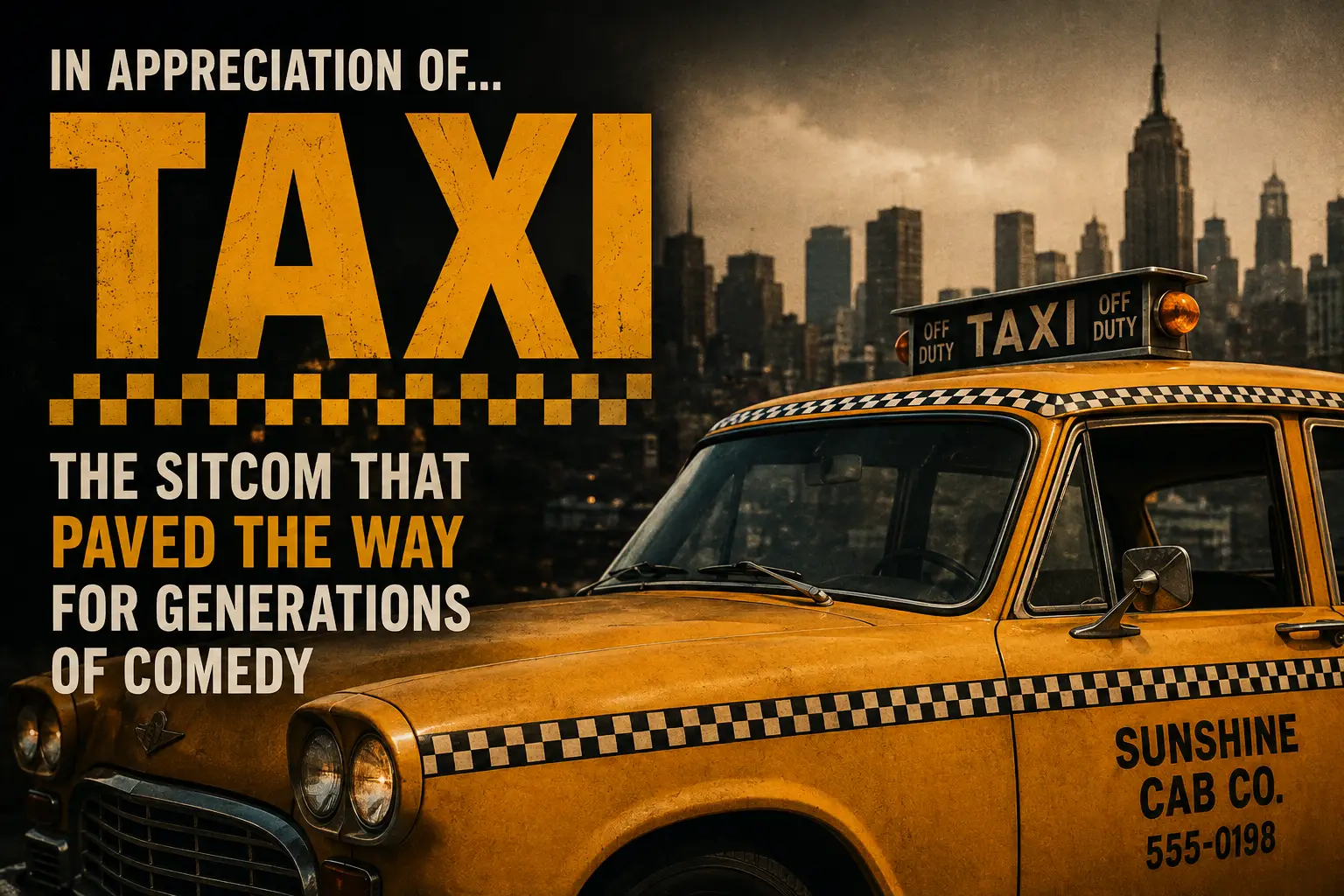
Taxi focused on the staff of the Sunshine Cab Company in New York City, almost all of whom wished they worked anywhere but there. Its stars went on to great things, including two-time Oscar-nominated Judd Hirsch, Christopher Lloyd, Danny DeVito, Tony Danza, and more.
The Writing – Right Place, Wrong Time
Taxi’s sensibility came a few years too late—and a decade too early.
What made Taxi brilliant was that it had great characters, all of whom had dreams that didn’t include driving cabs. Bobby wanted to be an actor. Elaine, to run an art gallery. Tony, a boxer… yet the show itself remained stubbornly anti-escapist.
These characters seldom achieved any real success, which gave the show a melancholic realism that didn’t exist in other, more escapist types of sitcoms. This was all reinforced by the beautiful, soulful jazz tracks from Bob James, which truly set the mood of the show.
This fit in well with sitcoms of the early 1970s, like MASH and All in the Family, which dealt with real-world issues in often surprising and funny ways.
The problem for Taxi was that, by the time it aired, these shows were on the decline. More escapist fare like Three’s Company and The Love Boat were on the rise.
Where its mood was a few years too late, its writing and themes were years and often decades ahead of its time.
All-Star Writing Staff
Writers and producers from Taxi would go on to shape series like Cheers, Newhart, Coach, Frasier, and even The Simpsons, among countless others.
One of Taxi’s concepts was focusing on a “chosen family,” where the focus remained on an ensemble staff at work and didn’t follow a single character home at the end of the day. This DNA went right into Cheers, which was written by the Charles Brothers, who were also the head scribes of Taxi. This format also found a new footing with mockumentaries like The Office and Parks & Recreation.
The Office also benefited from the concept of the terrible boss. Danny DeVito’s Louie DePalma was about as awful a human being as anyone could come up with, but the writers always knew just how far they could push him before the audience would lose their human sympathy for him.
Watch Louie here trying to be a better person, and completely failing…
The Right Seasoning of Characters
Taxi understood that not every character should occupy the same amount of screen time. The show benefited greatly from two comic geniuses… one by accident.
If you’ve never heard of Andy Kaufman, that wouldn’t be surprising. He died in 1984 (probably) of lung cancer, despite never having smoked a day in his life. His method comedy was a forerunner of Sacha Baron Cohen. His character of “Foreign Man,” which predated the series, was a naive, poor Eastern European immigrant who even included his own made-up language.
The writers understood Kaufman’s brilliance and did everything they could to get him on the show. They even allowed him to work part-time while the rest of the cast appeared in every episode. They also understood that Latka worked best as seasoning rather than the main course. A little of him went a long way.
This is one of his longer bits.
Then… there’s Reverend Jim.
Christopher Lloyd had a small, guest-starring turn in Season 1 of the series as a burnt-out preacher leftover from the 60s. But he turned out to be popular with fans, and his down-and-out story mixed with his spaciness was the right blend of funny/sad for the series. So they brought Jim back for another episode in early Season 2… which went on to be one of the all-time classic bits in sitcom history. Have a look here:
Taking Controversy Head-On
Jim’s drug addiction, while often played for laughs, was one of the controversial parts of the series. At that time, drugs were often saved for special moralistic episodes, but when Jim became a central character, it paved the way for portraying addiction as part of a character rather than simply as the subject of a “very special episode.”
Likewise, the series had multiple episodes featuring LGBTQ themes, including one in 1980 that featured bisexuality as its centerpiece. That broke taboos for the time… with Latka hilariously mistaking it for something that has to do with bicycles to emphasize how little the subject was discussed before.
The series also didn’t shy away from gender politics. Marilu Henner’s Elaine was often the subject of sexual harassment from DeVito’s Louie, to the point where she is forced to go on a date with him in order to settle a union dispute. In 2026, this episode is pretty uncomfortable to watch… including where he asks for a kiss to close out the night:
The Legacy of Taxi, 48 Years Later
The creative DNA of Taxi flowed into Cheers, and from there into much of the next four decades of television comedy.
Its bittersweet blend of comedy and melancholy can still be seen in series like The Bear, where flawed people—not perfect heroes—are what keep audiences coming back. Like many great shows, it arrived ahead of its time and paid the price for it.
Taxi ranked as high as the ninth-most-watched series in its first couple of seasons, when it had the massive hit Three’s Company as a lead-in. You wouldn’t think those two would work together… and clearly the executives at ABC didn’t either. Season 3 saw Taxi bouncing all over the schedule, which was a huge problem in 1981 when you had to watch TV at the time it came on. It was canceled after Season 4, received a one-season revival at NBC before the Sunshine Cab Company closed for good.
Episodes like that one, and the Elaine/Louie date, certainly mark Taxi as a product of its time. But most of it still holds up today.
In the end, like a lot of great art, Taxi wasn’t hugely successful at the time. It was critically acclaimed. It bounced around. It got canceled twice. Yet more than 40 years later, it’s arguably one of the most influential sitcoms ever made.
Nearly 50 years after it debuted, Taxi still feels surprisingly modern. That’s about the highest compliment I can give it. If you have Paramount+, it’s worth a look—or a revisit.